TRR editors, Jessica, Baeli, and Iden are graduating this year! We are so happy for them but sad to see them leave. Thank you for all you have done for TRR!
A special thanks to Baeli, the graphic designer for TRR! The amount of work you put in is incredible.
Hi! I’m Libby Bradbury, and I’m a sophomore here at LC State. I’m majoring in Publishing Arts and minoring in Psychology. The end goal is to be a book editor. Reading has always been a favorite hobby of mine, and I have a knack for noticing mistakes in the books I read. Someday, I hope to write my own novel, which I try to work on during summer and winter breaks. I recently became an intern with the Talking River Review literary journal at LCSC. I enjoy it and I look forward to continuing my editing journey.
Apart from attending full-time classes and working part-time in the LC State Admissions Office, I am typically found at home. I have always been an introverted homebody, and after a long day of being out and about, I like to curl up on my couch and watch a movie with my brother. I also like trying out new recipes from thrifted cookbooks. When I need some quiet time, I prefer to settle in with my favorite book and light a new candle. On weekends, I like to visit my parents in Orofino, where I grew up.
The last book I read was essentially a modest holiday tray of baklava bites: tons of little snacks, all with flaky and delicious layers. Neatly packaged in a breezy 177-pages, Dept. of Speculation by Jenny Offill gives readers just enough to chew on with short chapters and even shorter paragraphs. It’s one of those “read in one sitting” books. Because of her engaging writing style—italics, all caps, parentheticals, numbered lists, hypothetical Q&A, unmarked dialogue, unique point of view—you keep reading, eager for another reference of a well-known philosopher, another deadpan joke, or another heartbreaking image, the details of which will stick to your fingers. Offill’s realistic dive into the inherent and unavoidable dilemmas found within a romantic partnership and within motherhood reverberates with me still. What else should we do with our time but speculate about our world and our place in it, one bite at a time?
I’m partial to stories that bookend themselves. The text begins with a Black man standing literally and metaphorically on the edge. Frustrated with life—with the treatment of Blackness in the world in which he resides—he leaps from the roof of Mercy Hospital, clad in blue silk wings. Broken-hearted, he takes with him a precious, generational secret—about Blackness and bodies that can soar away from life’s cruelties. This man, Robert Smith, dies just as Macon Dead Jr. (Milkman) is about to draw his first breath. Later, at the end of the book, Milkman will also take flight—no longer fearing the profound weight of his family, life under Jim Crow, or even death. In between these two moments, Morrison explores American history, ethnography, and Magical Realism—all wrapped up in a love story about how why Black people must learn to adore themselves… in order to achieve freedom.
I read this book every year. It’s that good, and that important to me as a Woman of Color and a writer. As an undergraduate, I remember feeling very adult once I took up the tome. It made me feel as if I understood something profound about the world and about myself. Like everything Morrison has written, it simply settled in my bones and upon my skin. It’s a work that simply…matters.
Welcome back! My name is Jenna Creitz, and I am a junior pursuing my publishing arts degree here at LC State. You can find my name under “Editorial Staff” in Issue 59 and the upcoming Issue 60, which is something I never imagined when I first started taking college classes. As someone conditioned to believe I had to pursue “practical” degrees such as accounting or business administration, being part of TRR these past two semesters has been an eye-opening experience that aligns with what I enjoy doing. I look forward to continuing this journey and having my name listed as “Editorial Staff” in future issues, but I shall make no promises.
I’d love to say that I am more active around campus; however, between full-time classes and full-time work, I tend to find myself drained by the end of the week. During the semester, my free time is typically spent watching some light-hearted TV with my husband or reading. It’s actually thanks to my husband that I got back into reading and found the motivation to read 175 books in one year. He also sparked my renewed interest in going back to school and pursuing a degree where I look forward to the classes I take, and experiences like TRR have helped reinforce that choice.
I’m excited for you to see Issue 60 in its entirety, and I look forward to helping build the next issue.
Hello! I’m Kassi Weston, a Creative Writing and Justice Studies major at Lewis-Clark State College. This is my third year at LC and I made the decision to double major so I can take advantage of the Study-Abroad program LC has to offer. I plan on (hopefully) going to London in the summer of 2027 to improve my education on literature as well as the criminal mind. After I graduate in 2028, I hope to become a full-time Investigative Journalist, working for the Lewiston Tribune.
I am currently a freelance writer for the Trib, having started in November of 2025. So far, I have published two stories: one about an amazing woman who won librarian of the year in 2025, and the other about the anniversary of the local chapter of The League of Women Voters. Currently, I am writing another about a very kind couple that have spent the last 15 years working on a garden that is now known as “The Enchanted Forest.” All three are a part of the Trib’s Golden Times section. One thing I love about my job as a freelance writer is all of the people I get to meet. I learn so much from each person I meet during this journey, and I feel like I take a little piece of their wisdom with me into every little thing that I do.
While I have only served on the Talking River Review team for one semester (Fall of 2025), I learned a lot from the other members: how difficult the task of editing is, and how rewarding it feels when a literary journal is published. During my time, I read a lot of different pieces, but I feel like the part I enjoyed the most was being able to interview two of three artists that were being featured in the issue we were working on. I felt that being able to do these interviews really helped me solidify some interview-skills that I can take with me in my journalistic career.
Since I am not able to be a part of TRR every semester, I do promote the hard work that is done by my peers through my position as Student Ambassador of the Humanities Division. I am only the second student to have this position, stepping in in September of 2025, but I love the work that I do. Through this, I am able to be a part of activities like, the Creative Writing Contest for high school students that takes place every year. I get to promote how amazing our Humanities programs are, as well as how great it is to be a Humanities student. I also manage the social media for the division, which allows me to highlight students, classes, and events that we have been able to put on or be a part of.
When I am not running around like a chicken with my head cut off, I am reading, writing, watching any kind of true-crime documentary that I can find on Netflix, and annoying my boyfriend, Alex. I am from, roughly, 7 hours from Lewiston, so I love being able to learn as much as I can about the area and meeting as many people as I can to establish long-term relationships. When I am in my hometown, I spend time with my amazing parents and chase around my dog, Rocky, that we rescued around Christmas of 2024. One thing I love being able to do while I am home is go camping, be outside in the sunshine, and create lasting memories with family and friends.
Kassi Weston kneeling on the ground next to her dark brown dog, Rocky, in front of a barbed wire fence, trees, and mountains.
I love academic satire. Classics of the genre such as Richard Russo’s Straight Man (1997), Jane Smiley’s Moo (1995), and Don DeLillo’s White Noise (1985) have long been among my favorite novels. Two of the best recent additions to the genre are Julie Schumacher’s Dear Committee Members (2014), an epistolary novel told almost entirely through letters of recommendation, and her 2018 follow-up, The Shakespeare Requirement. Both novels center on the misadventures of Jason Fitger, a hapless English professor at the aptly named Payne University who finds his love for writing submerged in a sea of bureaucratic toil and personal disappointment. So, as I was recently walking through a local bookstore, I was delighted to discover that there is a third installment in Schumacher’s series—the 2024 novel The English Experience. The novel follows Fitger, now chair of the English department, as he is compelled to teach a January-term class in London for the university’s “Experience: Abroad” program. (Fitger takes as much issue with the gratuitous colon in the program’s title as he does with the idea of spending his break chaperoning unruly students in an unfamiliar city.) The story alternates between traditional third-person narration centering Professor Fitger and the daily essays that the students submit while on the trip. The students bond over the bad food, bad weather, and what they see as the unreasonable workload inflicted on them by the professor. It is perhaps embarrassingly obvious why Schumacher’s novel holds such appeal for me: as a middle-aged English professor, I see my life reflected in Fitger. The simplest and greatest delight of literature is identification—to find our sorrows and joys, our anxieties and passions, represented in the pages of a good book. A professor herself, Schumacher also has a talent for capturing the absurdity and sweetness of academic life.
Hello! My name is Jennifer Anderson. I’ve been fortunate to teach English & creative writing at LC State for the past seventeen years. Since 2019, I’ve also served as the faculty advisor for the Publishing Arts program and Talking River Review. I’m so proud of the TRR team and the excellent work they do every semester in developing each issue from scratch.
I was born and raised in Idaho. In fact, I’m an LCSC alumnus, graduating in 2000 with a bachelor’s degree in English. In 2005, I received my MFA in creative writing (with an emphasis in creative nonfiction) from the University of Idaho.
In my spare time, I enjoy bass fishing up the Snake River, gardening, bicycling with my husband, and playing with my one-year-old pitty-husky rescue, Delilah. This spring, Delilah and I are enrolled in AKC Canine Good Citizen classes. Though I’ve been an avid dog-lover and owner my entire life (over the past twenty-six years, my husband and I have adopted five shelter dogs), I’m learning so much about how to be a better dog communicator and companion.
Light brown dog lying on the ground looking up at Camera.
Of course, I’m also passionate about reading and writing; right now, I’m particularly interested in trying my hand at flash essays comprised of 500-words or fewer. Below, I’ve included a piece I wrote for the LC Valley Field Guide, a cross-disciplinary project inspired by Cascadia Field Guide, which several LC State classes collaborated on last fall, and which featured work by over 100 students and several faculty members. In July of 2025, after receiving my first-ever colonoscopy at age forty-nine, I was diagnosed with colon cancer, and I wrote this in August right before I had a sigmoidectomy. Fortunately, my surgery was a success, and everything is now looking great. If you are forty-five or older (as is now recommended), get a colonoscopy!
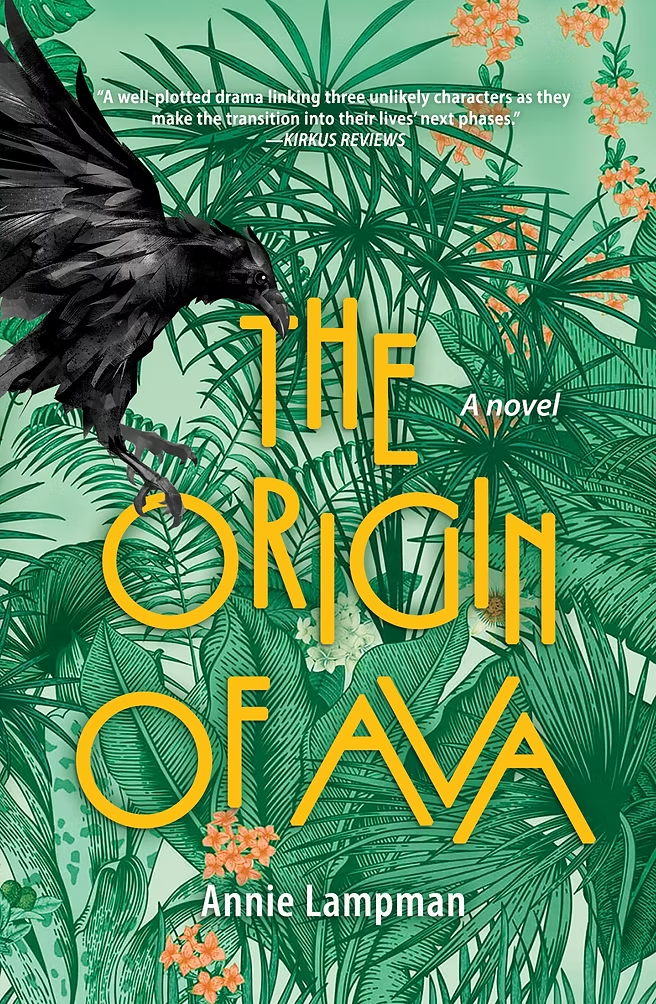
Black Feathers
Every evening, from April to July, dozens of crows gathered in the honey locust and red chokecherry trees surrounding my house. I listened to their chatter, their cooing, clicking, and cawing. Some snacked on chokecherries; others preened. The topmost branches rustled and swayed with each new arrival, and I found myself whispering, “Here they come,” as I watched the choir assemble.
Never before this—not once in twenty years—had they stopped at our house, though they’ve been roosting in our neighbors’ giant maples for a long time now. But in early April, around my husband’s fiftieth birthday, they began congregating in the dying honey locusts we know must come down, in the cherry trees we planted in 2005 for shade. They never stayed for more than a half hour, and they never missed a day. Our trees suddenly became the place for this pre-roosting aggregation, a rest stop before the sixty or so of them flew across the street for the night.
I left them gifts—peanuts, dog food, sunflower seeds—because I’d read they might leave tokens in return. They never took what I offered and left behind only the rare black feather, sticking up out of the ground as if an exclamation mark or an arrow pointing here! Then, on July 9th, the same day I was diagnosed with cancer, dusk came and went without a sound.
Now several months have passed, and the crows have not returned. Sometimes a handful still roosts in my neighbors’ maples, but no more than that. True, the chokecherries dried up when the days turned hot. It’s likely the flock found another food source, and they convene somewhere else for the night. Once, on our evening walk, my husband and I found them in the cemetery two blocks away, clustered on the twisted limbs of a snag, their calls swallowing up all other neighborhood noise. Crows can recognize human faces. Did they know me as I stood beneath them, and what did they say?
Some cultures believe visits from crows indicate a transformation, a change on the horizon, and they will keep coming, day after day, until their message is received. Some consider them omens of death. Others believe finding their feathers brings protection and good luck. I’ve never been a spiritual person. Even as a young girl in church, I questioned the existence of God.
And yet.
When faced with so many unknowns, I find myself listening for the tidings of crows at dusk. I keep searching my garden for feathers.
Tara Karr Roberts’s 2024 novel Wild and Distant Seas offers a fresh perspective on feminine resilience and the power of memory. This narrative is about four women who are all connected to the character Ishmael from Herman Melville’s 1851 novel Moby-Dick.
Wild and Distant Seas begins with Evangeline Hussey, the matriarch of four generations, who possesses a magical gift (that will eventually be passed down to her descendants). Evangeline hosts Ishmael at her inn on Nantucket before he sails away to hunt the infamous white whale. After their brief, but strong, connection, Evangeline is left with a secret child, prompting these remarkable women to navigate their own lives, their journeys spanning across Nantucket to Boston, Brazil, Florence—even Idaho—as they also search for the truth of their family legacy.
There were times I’d forget I was reading until I needed to turn the page of this beautiful novel. The language is so vivid, it’s hard not to imagine walking alongside these women in the bustling streets of cities or gently rocking on the waves in a steam ship or looking out a train window, watching the grasses of the prairie go by. Unputdownable. That’s what this book is!
With lyrical prose and beautifully written characters, Wild and Distant Seas focuses on the perspective of the women who were left out of stories of male ambition, making this a great read if you’re seeking female-centric and atmospheric historical fiction.
Poster with circles and a sperm whale in the middle containing details about Tara Karr Roberts’s reading. Reading is at the Lewiston Public Library on Friday, April 10, 2026 at 7:00 p.m.
This is no coyote’s warble and bark. It soars into the canyon’s very stones and sets the pine needles quivering. Even the moonlight trembles.
Maybe the wolverine, most fearless and furtive of all these woods’ creatures, does not take note. Maybe the bull moose, placid and massive, merely nods.
But the cliffs stand still and listen, and the creek picks up its nervous pace. Deer bedded down in their thickets test the wind, consider again the avenues of flight.
At my feet in the tent, the dog whimpers. How much, she must wonder, can any man be trusted, and what of these walls that god-cry passes through like a sermon?
Or coming back, its ever fainter echo, like a whisper, saying what, saying why, saying who? It is 1:01 a.m. By moon glow 1 see her silhouette shiver.
By matchlight, her pupils, blue-green and bottomless, shine back at me. 1 am in them, looking her way, and something else—movement,
canter, stealth in the blood— when in the tent’s windless basilica, among our two held breaths, the match flutters once, and goes out.
AFTER THE FLOOD
These are the halcyon days of heavy equipment, the back-up beeps from bulldozers and dump trucks more common than bird song, the air, my wife maintains, so redolent of testosterone a deep breath can bring on a beard. Yesterday we watched two men in a motorboat salvage lumber from a back-eddy pool. The river boiled beneath them, treacherous with deadheads and flotsam. Neither man wore a life jacket of course. We’d spread a blanket under a tree, the kids collected ladybugs for the garden. I wanted to kiss her neck, her shoulders bare in the sun for the first time in months. Your age, she said, or younger. I reconsidered my cigar. By now they must have had enough lumber to frame a small house or a barn—two-by-sixes, two-by-eights, straight-grained fir and pine, no common yard stuff, only select. Imagine starting over, she said. A gable floated by, a tatter of black tarpaper trailing. For a moment, I was a hole in the air, like the shape of a house where a house had been, or a room— a bedroom after love, the kitchen by meal light and laughter. Everything gone, she said. And it was, the scrape and beep of roadwork, the furtive, early bird songs, even the calls of the children at another vivid hatch of bugs. I was falling into the light, I think, I was swallowed by silence, when the line came, the outboard whine driving men and wood upstream, and one man— bless his fool heart and mine— waved his cap at us and whooped. They had all they could carry this load. They’d be back to begin again. I rose from where I lay and nuzzled her neck. She laughed and shrank from the itch of my whiskers, then turned and kissed me back.
Robert Wrigley is Distinguished Professor Emeritus at the University of Idaho. He has published thirteen books of poems, most recently The True Account of Myself As a Bird (Penguin Random House, 2022). He lives with his wife, the writer Kim Barnes, on Moscow Mountain.